

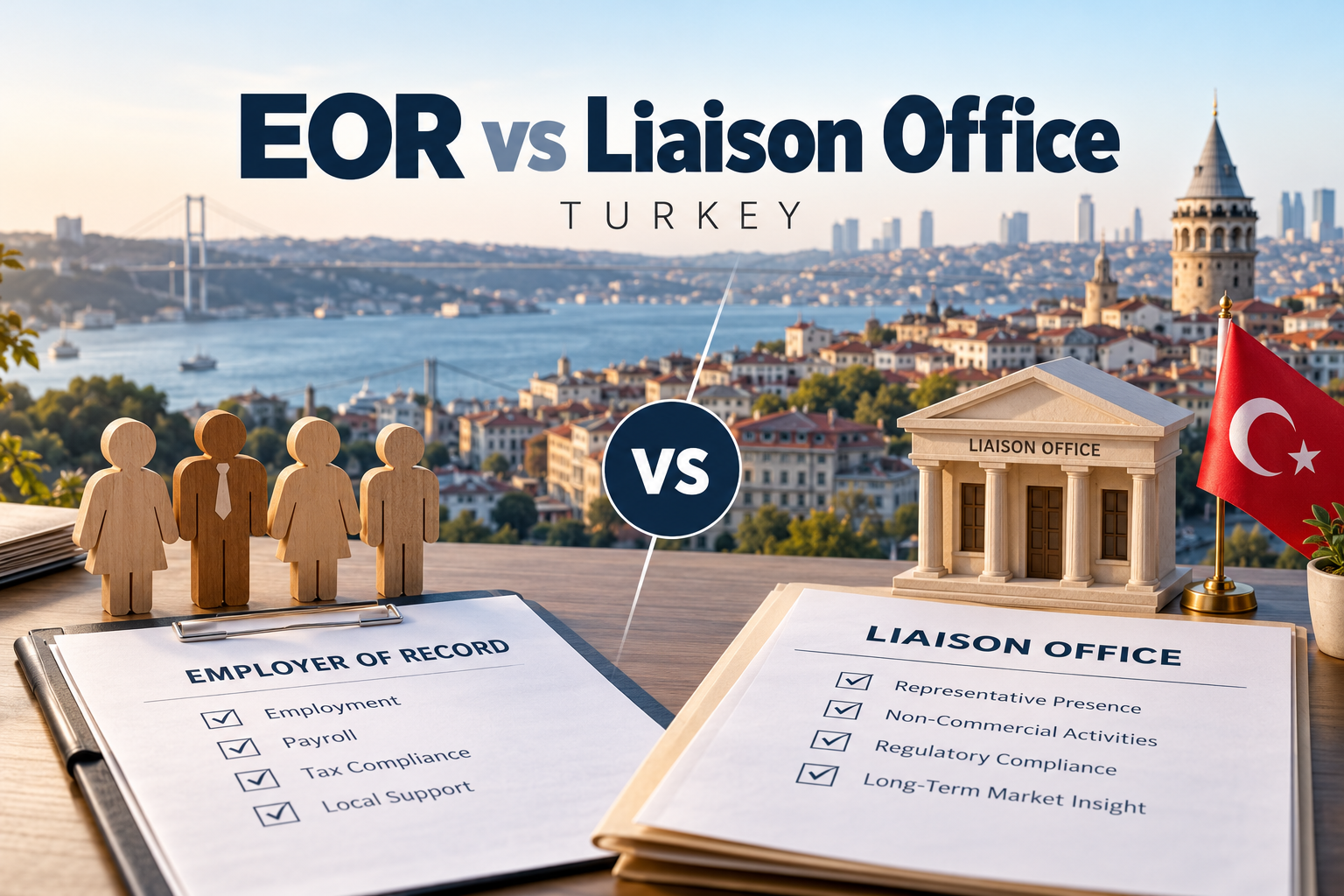
EOR vs Liaison Office Turkey is an important comparison for foreign companies planning to hire employees or establish a presence in the Turkish market. Both options allow international businesses to operate without incorporating a local subsidiary, but they differ significantly in employment arrangements, taxation, legal requirements, and administrative responsibilities.
Both options allow international businesses to operate in Turkey without incorporating a local subsidiary. However, they serve different purposes and have distinct implications for employment, taxation, compliance, and long-term business operations.
An Employer of Record (EOR) enables a foreign company to hire employees through a local employment provider. A liaison office, also known as a representative office, allows a foreign company to establish an officially registered presence in Turkey for approved non-commercial activities.
The right choice depends on more than setup costs. Companies should consider the number of employees, the nature of their activities, payroll taxation, administrative responsibilities, and how long they intend to maintain operations in Turkey.
This guide explains the differences between EOR and liaison office structures in Turkey, including their advantages, limitations, and practical applications.
What Is a Liaison Office in Turkey?
A liaison office (İrtibat Bürosu) is a non-commercial office established in Turkey by a company incorporated abroad.
It allows the foreign parent company to maintain a formal local presence without establishing a separate Turkish legal entity. Unlike a limited liability company or branch, a liaison office cannot engage in commercial activities or generate revenue in Turkey.
Establishment requires authorization from the Turkish Ministry of Industry and Technology.
Depending on the approved activity category, a liaison office may carry out functions such as:
- Market research and feasibility studies.
- Promotion and representation of the foreign parent company.
- Supplier identification and coordination.
- Quality control and inspection activities.
- Technical support and information gathering.
- Regional coordination and management activities, where specifically authorized.
The office must operate within the scope of its permit. For example, a foreign manufacturer may establish a liaison office to monitor Turkish suppliers and coordinate quality inspections, but the office cannot directly sell products or invoice customers in Turkey.
This distinction is particularly important for foreign businesses planning to employ sales, business development, or customer-facing personnel.
Activities involving contract negotiation, commercial commitments, or revenue generation must be carefully evaluated to determine whether they are compatible with the liaison office’s authorized scope. For a detailed explanation of the application process, permitted activities, and regulatory requirements, see our guide to liaison office establishment in Turkey.
Liaison Office Tax Advantages in Turkey
One of the main reasons foreign companies consider establishing a liaison office is the potential income tax exemption available for employee salaries.
Under Article 23/14 of the Turkish Income Tax Law, salaries paid by qualifying foreign employers may be exempt from Turkish personal income tax, provided the applicable statutory conditions are satisfied.
These conditions generally concern the foreign employer’s status, the source of the salary payments, and the requirement that remuneration be paid in foreign currency from funds originating abroad.
For qualifying employees, this can produce meaningful payroll savings, particularly where compensation levels are relatively high.
However, the exemption should not be confused with a complete exemption from employment-related obligations.
Employees of liaison offices are generally still subject to Turkish social security contributions (SGK), and other applicable employment-related requirements remain in force.
A foreign company should therefore assess the full payroll cost, rather than assuming that operating through a liaison office eliminates all employment taxes and contributions.
Liaison Office Setup and Compliance Requirements
Establishing a liaison office involves a formal application to the Ministry of Industry and Technology. Foreign companies can also review the official Invest in Türkiye investment guide for further information on liaison office establishment requirements and operating permits.
The application generally requires corporate documentation from the foreign parent company, information about the proposed activities, authorization documents, and supporting financial information.
Documents issued abroad may require notarization, apostille or consular legalization, and certified Turkish translations.
The Ministry’s stated processing period for a complete application is generally 15 working days. However, the overall establishment timeline may be longer when document preparation and post-approval registrations are included.
Initial operating permits may be granted for up to three years.
Extensions depend on the approved activity category and the Ministry’s evaluation. Importantly, permits issued solely for market research or promotion of the foreign company’s products or services are generally not eligible for extension.
Once established, a liaison office must comply with ongoing obligations, including maintaining the relevant records, reporting certain changes, and submitting its annual activity information to the Ministry by the end of May.
The foreign parent company must also finance the office’s expenses through funds transferred from abroad.
These requirements make a liaison office a formal operating structure rather than a simple alternative to outsourcing payroll.
What Is an Employer of Record (EOR) in Turkey?
An Employer of Record in Turkey is a local employment provider that formally hires personnel under its own legal entity while providing employment administration services to an international client.
This arrangement allows foreign companies to engage local employees without establishing their own Turkish subsidiary.
For example, a European technology company may want to hire two software developers in Istanbul. Rather than incorporating a Turkish company solely to employ these individuals, it may work with an EOR provider that manages the local employment relationship and payroll administration.
The foreign company remains involved in defining the employee’s responsibilities and operational objectives, while the EOR provider handles the agreed employment administration.
Typical EOR services include:
- Preparation and administration of employment contracts.
- Employee registration with the Social Security Institution (SGK).
- Monthly payroll calculations and salary payments.
- Income tax and statutory contribution calculations.
- Leave and employment record administration.
- Employment-related reporting and documentation.
- Support with onboarding and termination procedures.
The foreign client generally receives a monthly invoice covering employment costs and the agreed service fee.
An EOR arrangement can significantly reduce the administrative work required to employ personnel in Turkey.
However, EOR is not a separate statutory employment category under Turkish law. The contractual structure, actual working relationship, and allocation of responsibilities must be evaluated under the applicable employment legislation. Our comprehensive guide to Employer of Record in Turkey explains the employment structure, payroll obligations, and legal considerations in greater detail.
How Quickly Can an EOR Hire Employees in Turkey?
For straightforward cases involving Turkish citizens, EOR onboarding can often be completed within a few business days once the required information, documentation, and employment terms are agreed.
The process typically includes confirming the salary package, preparing the employment contract, collecting employee information, and completing the necessary SGK registration before employment begins.
The timeline may be longer when the arrangement involves additional contractual requirements, complex compensation structures, or foreign nationals requiring work permits.
Unlike establishing a liaison office, the foreign client does not need to obtain a separate Ministry authorization to establish its own local office.
This makes EOR particularly useful when a company has already identified a candidate and wants to begin employment without undertaking a corporate establishment process.
EOR Payroll Taxes and Employment Costs
Employees hired through an EOR are generally subject to ordinary Turkish payroll taxation.
Depending on the employee’s salary and applicable circumstances, the employer’s total cost may include:
- Gross salary.
- Employer social security contributions.
- Employer unemployment insurance contributions.
- Applicable employee benefits and allowances.
- The EOR provider’s service fee.
Personal income tax, employee social security contributions, unemployment insurance contributions, and applicable stamp tax must also be reflected in payroll calculations.
For employees receiving a guaranteed net salary, the total employer cost can change throughout the year because Turkish income tax is progressive.
Before hiring, foreign companies should request a payroll cost simulation showing the estimated monthly and annual costs.
This provides a more reliable basis for comparing EOR with other employment structures.
EOR vs. Liaison Office in Turkey: Key Differences
The following table summarizes the main differences between the two options.
The EOR vs Liaison Office Turkey comparison becomes particularly important when evaluating employment costs, regulatory requirements, and the level of operational flexibility each structure provides.
| Feature | Liaison Office | Employer of Record (EOR) |
|---|---|---|
| Main purpose | Formal non-commercial presence | Employment through a local provider |
| Turkish subsidiary required | No | No |
| Establishment approval | Ministry authorization required | No separate establishment approval for the foreign client |
| Setup timeline | Several weeks may be needed, including documentation | Often a few business days for straightforward onboarding |
| Employee income tax | Exemption may apply if conditions are met | Standard payroll taxation generally applies |
| Social security | Generally applicable | Generally applicable |
| Local office | Formal office presence required | No separate office required for the foreign client |
| Commercial activities | Limited to authorized non-commercial activities | Depends on the lawful employment arrangement and actual duties |
| Ongoing administration | Local registrations and reporting obligations | Employment administration managed by the provider |
| Closing operations | Formal closure procedures | Contractual exit and applicable employment termination procedures |
| Typical use | Long-term representation, coordination, supplier monitoring | Small teams, remote employees, project-based hiring |
Neither option is automatically superior.
A liaison office may offer payroll tax advantages and a formal presence, while EOR generally provides a simpler route to employing personnel.
The decisive factor is whether the structure is appropriate for the company’s intended activities.
When Should a Foreign Company Choose a Liaison Office?
A liaison office is generally worth considering when a foreign company intends to maintain an ongoing non-commercial presence in Turkey.
In the EOR vs Liaison Office Turkey decision, a liaison office may offer advantages for companies planning a stable, long-term presence focused on non-commercial activities.
For example, an international manufacturing business may need several employees to coordinate local suppliers, monitor product quality, and report to its overseas headquarters.
Where these functions are covered by the office’s operating permit, a liaison office may provide a suitable structure.
It can also be attractive for companies expecting to maintain a relatively stable team over several years.
If the salary income tax exemption applies, the potential savings may outweigh the costs of establishing and maintaining the office.
However, there are important limitations.
A liaison office cannot be used as a substitute for a Turkish subsidiary when the business intends to conduct local commercial activities.
The company must also consider office expenses, reporting requirements, the duration of its permit, and restrictions on permitted activities.
For businesses whose primary objective is simply to hire one or two employees, establishing a liaison office may introduce unnecessary administrative complexity.
Companies considering a more permanent presence should also understand the differences between a liaison office and a branch office in Turkey, particularly regarding commercial activities and taxation.
When Is an EOR the Better Choice?
An EOR is often more suitable when a foreign company needs to hire employees in Turkey without creating a formal local office.
In the EOR vs Liaison Office Turkey comparison, EOR is often the more practical option for companies seeking to hire a small team without establishing a formal local presence.
Common examples include:
- Hiring one or two remote employees.
- Recruiting software developers or technical specialists.
- Building a small customer support team.
- Employing personnel for a defined project.
- Testing staffing requirements before establishing a Turkish subsidiary.
Consider a foreign technology company that wants to employ a developer and a technical support specialist in Turkey.
If the company does not need a registered representative office, establishing a liaison office solely for these employees may be unnecessarily complicated.
An EOR can provide the required employment administration without a separate establishment process for the foreign client.
EOR can also be useful as an interim arrangement while a company evaluates its longer-term plans in Turkey.
Nevertheless, the model should not be treated as eliminating all legal or tax exposure.
Depending on the employee’s activities and authority, issues such as permanent establishment risk, employment-law compliance, and the suitability of the EOR structure may require separate consideration.
Is a Liaison Office Cheaper Than an EOR in Turkey?
The answer depends largely on the number of employees, compensation levels, and expected duration of operations.
From a financial perspective, the EOR vs Liaison Office Turkey comparison should consider both immediate establishment expenses and the total cost of employing staff over several years.
A liaison office involves establishment expenses, ongoing administrative requirements, and the cost of maintaining a registered office.
However, where the relevant conditions are satisfied, the income tax exemption on salaries may reduce the overall payroll cost.
An EOR usually involves standard payroll taxation plus a monthly service fee. In return, the foreign company avoids the administrative burden of establishing and maintaining its own local office.
For a small team employed for a relatively short period, an EOR may be the more economical and practical choice.
For a larger team with higher salaries and a long-term non-commercial function, a liaison office may become more attractive.
A meaningful comparison should include:
- Total annual gross or net salary commitments.
- Employer SGK and unemployment insurance costs.
- Applicable employee income tax treatment.
- Establishment and ongoing office expenses.
- EOR management fees or liaison office administration costs.
- The expected duration of operations.
The comparison should also account for legal feasibility.
A structure that appears cheaper on paper may not be appropriate if the employees’ actual responsibilities fall outside the permitted activities.
Can You Switch From an EOR to a Liaison Office?
Yes. A foreign company may initially hire employees through an EOR and later establish a liaison office if its business requirements change.
However, the transition requires planning.
The liaison office must first receive its operating authorization, and the employees’ intended activities must be compatible with that authorization.
The existing EOR employment relationships must then be addressed appropriately, taking into account employment contracts, accrued employee rights, and social security procedures.
The transition is not simply an administrative change of employer.
Depending on the circumstances, employee consent and additional employment documentation may be necessary.
If the company’s long-term objective involves local commercial operations, establishing a Turkish limited liability or joint-stock company may be more suitable than a liaison office.
Frequently Asked Questions
Can a foreign company hire employees in Turkey without opening a company?
Yes. A foreign company may use a properly structured Employer of Record arrangement to hire employees through a local provider without establishing its own Turkish subsidiary. The arrangement must comply with applicable Turkish employment law.
Are liaison office employee salaries tax-free in Turkey?
Qualifying salary payments may be exempt from Turkish personal income tax under Article 23/14 of the Income Tax Law. The exemption depends on specific statutory conditions. Social security contributions and other applicable obligations may still apply.
Can a liaison office issue invoices in Turkey?
No. A liaison office is not permitted to conduct commercial activities or generate revenue in Turkey. It cannot operate as a local sales entity or issue commercial invoices for its own activities.
Does an EOR eliminate permanent establishment risk?
No. Using an EOR does not automatically eliminate permanent establishment risk. The foreign company’s actual business activities, the employee’s responsibilities, and any authority to conclude contracts may be relevant to the assessment.
How long does it take to open a liaison office in Turkey?
The Ministry generally processes complete applications within 15 working days. However, preparing foreign corporate documents, obtaining legalizations and translations, and completing post-approval formalities can extend the overall timeline.
Can a liaison office employ foreign nationals?
Foreign nationals may work in a liaison office subject to applicable work permit requirements and eligibility conditions. Having a liaison office permit does not automatically authorize the employment of foreign personnel.
Is EOR suitable for long-term employment in Turkey?
An EOR may support ongoing employment arrangements, provided the structure remains legally appropriate. Companies planning a substantial or permanent local operation should periodically reassess whether an EOR, liaison office, or Turkish subsidiary is the most suitable option.
What happens when an EOR agreement ends?
Termination of the commercial agreement does not automatically remove employment-related obligations. Depending on the circumstances, statutory notice, severance pay, unused annual leave, and other employee entitlements may need to be addressed.
Conclusion: EOR or Liaison Office in Turkey?
The EOR vs Liaison Office Turkey decision ultimately depends on your company’s operational objectives, employment requirements, and long-term plans. While both options allow foreign businesses to maintain personnel in Turkey without establishing a subsidiary, their legal and financial implications differ considerably.
A liaison office can be an appropriate structure for foreign businesses requiring a formal, non-commercial presence in Turkey. Where the statutory requirements are satisfied, the potential income tax exemption for employee salaries may provide an additional financial advantage.
An EOR offers a more straightforward employment solution for companies that want to hire local personnel without establishing their own Turkish entity.
For a small team or an initial hiring requirement, EOR may provide the flexibility needed to begin operations. For a longer-term non-commercial presence involving several employees, a liaison office may deserve closer consideration.
Before selecting either model, companies should assess the employees’ actual responsibilities, total employment costs, regulatory requirements, and long-term plans.
Metropol Consulting assists international businesses with Employer of Record services, liaison office establishment, payroll administration, and employment compliance in Turkey.
If your company is evaluating these options, our team can help you compare the requirements and costs to determine an appropriate structure for your planned activities.
Foreign investors planning a broader market entry can also review the key considerations for establishing a company in Turkey, including corporate structure, taxation, and employment requirements.