

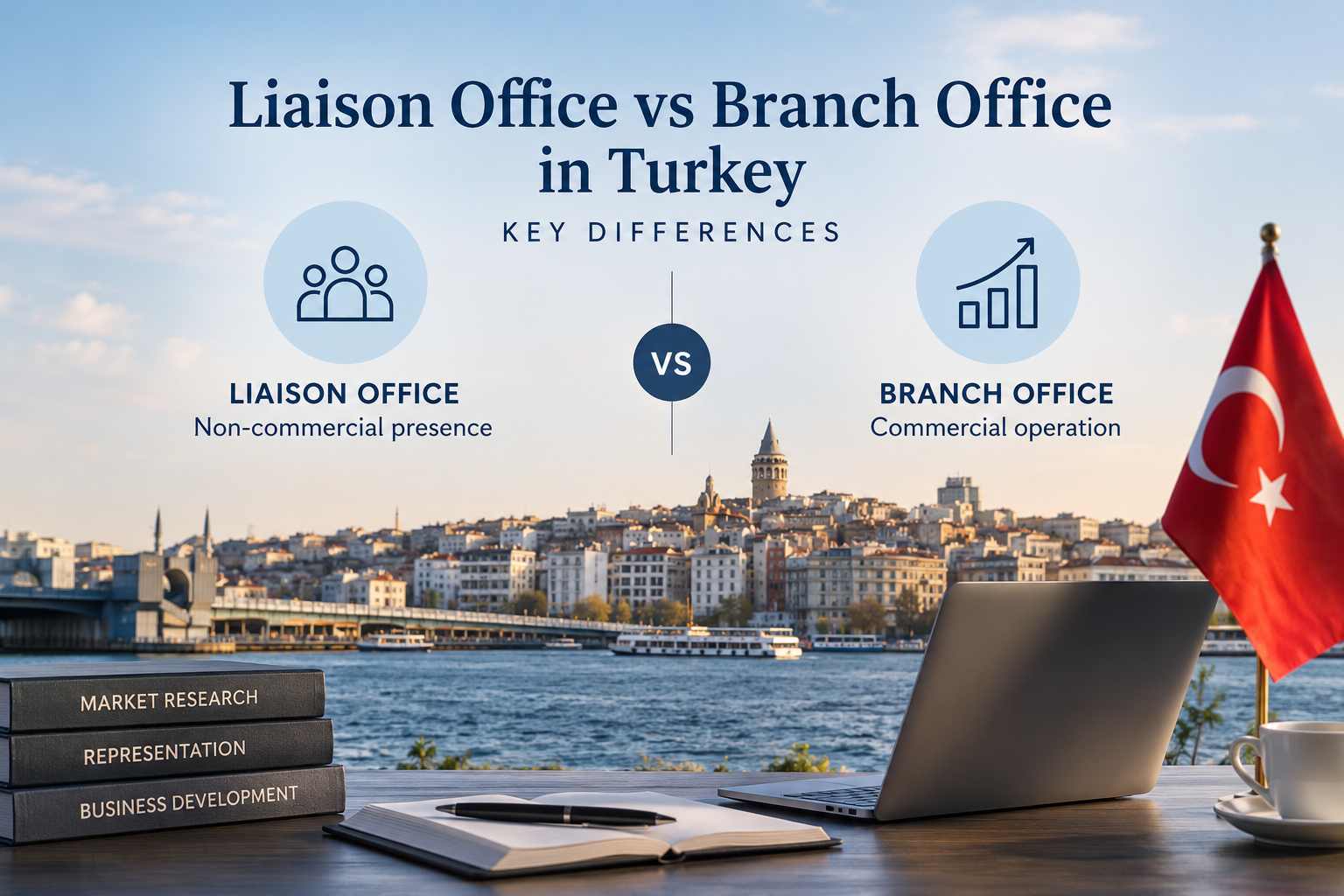
Foreign companies comparing a liaison office vs branch office in Turkey should first consider whether their planned activities will be commercial or non-commercial. Although both structures allow a foreign company to establish a presence without incorporating a separate Turkish subsidiary, they serve fundamentally different purposes.
The main distinction is straightforward: a liaison office is limited to authorised non-commercial activities, while a branch office can conduct commercial activities in Turkey.
That difference affects almost everything else, including registration, invoicing, funding, taxation and the way the Turkish operation interacts with customers.
This guide compares a liaison office vs branch office in Turkey from the perspective of a foreign company deciding how to structure its Turkish operations.
Liaison Office vs Branch Office in Turkey: The Core Difference
A liaison office is designed for foreign companies that need a presence in Turkey but do not intend to conduct commercial activities through that office. Establishment requires permission from the Ministry of Industry and Technology, and the office must operate within the activity specified in its permit.
A branch serves a different purpose. It is an extension of the foreign parent company that can carry out commercial activities in Turkey within the scope of the parent company’s business. A branch is registered with the Trade Registry and is not a separate legal entity from its foreign head office.
In practical terms, a company intending only to research the Turkish market, represent its foreign headquarters or perform another permitted non-commercial function may consider a liaison office. If the Turkish operation will sell goods or services, invoice customers or otherwise generate commercial revenue, a liaison office is not designed for that activity.
What Can a Liaison Office in Turkey Do?
Foreign companies may establish liaison offices in Turkey with permission from the Ministry of Industry and Technology, provided that the office does not engage in commercial activities.
Depending on the approved activity, a liaison office may be used for purposes such as market research, representation, promotion, technical support, communication and information transfer, supplier supervision or certain regional management functions.
The precise permitted activity matters. A liaison office should operate within the scope approved by the Ministry rather than treating its non-commercial status as a general authorisation to perform any activity short of issuing an invoice.
Most importantly, a liaison office cannot be used as the foreign company’s local sales operation. It should not generate commercial revenue or conduct business that falls outside the scope of its authorised non-commercial activities.
The initial liaison-office permit may be granted for a maximum of three years. Extensions depend on the permitted activity and the Ministry’s assessment of matters such as previous activities, future plans, expenditure and employees. Liaison offices authorised for market research or promotion of the foreign company’s products or services are not eligible for an extension under the current framework.
For the establishment procedure, permitted activities, employee tax treatment and annual reporting requirements, see our detailed guide to establishing a liaison office in Turkey.
What Can a Branch Office in Turkey Do?
A branch is a commercial presence of the foreign parent company.
Unlike a liaison office, it can conduct business, enter into commercial relationships, generate revenue and issue invoices in Turkey. Its activities must remain within the purposes of the foreign parent company.
The branch does not have its own shareholders and is not an independent legal entity. The foreign parent company remains the underlying legal person and is ultimately responsible for the branch’s obligations.
There is also no general statutory minimum capital requirement for establishing a foreign-company branch, although a budget can be allocated to its Turkish operations.
A branch must have a fully authorised commercial representative who resides in Turkey. The representative may be Turkish or foreign; the relevant commercial registration requirement is residence in Turkey rather than nationality.
For the registration procedure, required documents, taxation and profit repatriation rules, see our guide to opening a branch office in Turkey.
Liaison Office vs Branch Office in Turkey: Comparison Table
| Feature | Liaison Office | Branch Office |
|---|---|---|
| Separate legal entity | No | No |
| Main purpose | Permitted non-commercial activities | Commercial operations |
| Local sales | No | Yes |
| Commercial revenue | No | Yes |
| Local invoicing | No | Yes |
| Establishment authority | Ministry of Industry and Technology | Trade Registry |
| Initial operating period | Permit-based; initially up to 3 years | Linked to parent company |
| Funding | Operating expenses funded from abroad | May generate local commercial income |
| Corporate taxation | No commercial profit should arise from authorised activities | Turkish branch profits subject to corporate taxation |
| VAT on commercial sales | No commercial sales should arise | Ordinary VAT rules apply where relevant |
| Employee payroll | Local payroll and social-security obligations generally continue | Local payroll and social-security obligations generally apply |
| Employee income-tax treatment | Salaries can be exempt from income tax | Salaries are subject to income tax |
| Profit transfer to foreign head office | Not applicable as a profit-generating structure | After-tax branch profits may be remitted |
| Resident commercial representative | Different liaison-office representation rules apply | Fully authorised representative residing in Turkey required |
The comparison illustrates why the two structures should not be viewed simply as lighter and heavier versions of the same model. They are intended for different types of activity.
Establishment Process: Liaison Office vs Branch Office in Turkey
The establishment procedures are also different.
A liaison office requires an application to the Ministry of Industry and Technology’s General Directorate of Incentive Implementation and Foreign Investment. The application includes information about the foreign company, the proposed activities and the persons authorised to conduct the liaison office’s affairs. The foreign company must also undertake that the office will not conduct commercial activities.
A branch is registered through the Trade Registry system. The application generally requires the foreign parent company’s decision to establish the branch, constitutional and registration documents, information concerning the Turkish branch and powers granted to the resident branch representative.
Foreign-issued documents may also require apostille or other appropriate legalisation, together with Turkish translation and notarisation depending on the document and issuing jurisdiction.
The distinction therefore starts at establishment: liaison offices operate under a specific non-commercial permission, while branches are registered as commercial operations of foreign enterprises.
Tax Differences Between a Liaison Office and Branch Office
Tax is an important distinction, but the difference should not be reduced to saying that a liaison office is simply “tax exempt.”
A properly operating liaison office cannot engage in commercial activity. Accordingly, it should not generate commercial profits from its authorised activities in Turkey. Its position is therefore fundamentally different from a branch conducting revenue-generating business.
A branch, by contrast, carries on commercial operations and is registered for the relevant Turkish tax obligations. Profits attributable to the Turkish branch are subject to Turkish corporate taxation, and VAT and other tax obligations arise according to its transactions.
The difference follows primarily from what each structure is permitted to do, rather than from a general tax exemption granted merely because an operation is called a liaison office.
Employee Income Tax at a Liaison Office
One of the practical tax differences between the two structures concerns employee salaries. Salaries paid by a liaison office can be exempt from Turkish income tax, provided they are paid in foreign currency from funds transferred from abroad by the foreign parent company.
This treatment does not remove the liaison office’s payroll and social-security obligations. Employee salaries must still be processed through payroll, and the applicable social-security requirements continue to apply.
Employees of a commercial branch, on the other hand, are generally subject to the ordinary Turkish wage income-tax rules.
Funding: Another Important Difference
A liaison office does not finance itself through Turkish commercial revenue.
Its operating expenses are funded by the foreign parent from abroad, and evidence concerning funds transferred from abroad also forms part of the liaison office’s reporting framework. This reflects the fundamental nature of the structure: it supports the foreign company’s permitted non-commercial activities rather than operating as a local revenue centre.
A branch is different because it can conduct business and generate revenue in Turkey. It can therefore fund its operations through its commercial activities as well as through resources provided by the foreign head office.
This can become a practical dividing line where a company initially establishes a liaison office but later wants its Turkish team to begin contracting with customers or generating local revenue.
Profit Repatriation and Double Tax Treaties
Profit repatriation is relevant to a branch but not to a liaison office because the latter should not generate commercial profits in Turkey.
A branch can transfer its after-tax Turkish branch profits to its foreign head office. This transfer may be subject to withholding tax in Turkey, while the applicable double tax treaty between Turkey and the country of the foreign parent may provide a reduced rate. Official investment guidance expressly recognises the potential application of double tax treaties to branch profit remittances.
This becomes particularly important when a foreign investor is comparing a branch not only with a liaison office, but also with a Turkish subsidiary.
A Turkish subsidiary generally repatriates profits through dividends to its foreign shareholder, whereas a branch transfers its after-tax branch profits to its foreign head office. The applicable treaty treatment may differ between the two structures.
For this reason, the relevant double tax treaty should be reviewed before deciding between a branch and a Turkish subsidiary, particularly where regular profit repatriation is expected.
When Does a Liaison Office Make Sense?
A liaison office may fit a foreign company’s plans where the Turkish presence is genuinely non-commercial.
For example, the company may want to research the market, coordinate communication with its foreign headquarters, represent the group, support suppliers or perform another activity falling within the categories permitted by the Ministry.
It may also provide a way to establish a local presence before the foreign company is ready to begin commercial operations.
However, the structure should not be selected merely because its tax or administrative position appears lighter. If the actual business plan involves local sales, invoicing or revenue-generating contracts, the non-commercial limitation becomes the decisive issue.
When Does a Branch Office Make Sense?
A branch may be considered where the foreign company wants to conduct business directly in Turkey while maintaining the operation as part of the same foreign legal entity.
This can be relevant where the company wants to contract and invoice through its Turkish operation without establishing a separate Turkish subsidiary.
The trade-off is that the branch does not provide the legal separation of a subsidiary. The foreign parent remains responsible for the branch’s obligations, and the Turkish operation has its own accounting, tax, payroll and regulatory compliance requirements.
The applicable double tax treaty and expected method of profit repatriation should also be considered when comparing a branch with a subsidiary.
What About Establishing a Turkish Company?
The choice is not limited to a liaison office and a branch.
A foreign investor can also establish a Turkish limited liability company or joint stock company. Unlike both a liaison office and a branch, the Turkish company has its own legal personality. Where the Turkish company will have transactions with its foreign parent or other group companies, these transactions should also be considered from a transfer pricing perspective, particularly in relation to cross-border services, financing and other related-party transactions.
This can be preferable where the investor wants a separate local corporate structure, liability separation, its own shareholders, greater flexibility for future investment or ownership changes, or a business intended to operate independently from the foreign parent.
Foreign investors comparing these alternatives can review our guide to establishing a company in Turkey for the incorporation, capital, management and compliance considerations applicable to Turkish subsidiaries.
The practical comparison is therefore often between three alternatives:
Liaison office — non-commercial presence of the foreign company.
Branch office — commercial operation of the foreign company itself.
Turkish subsidiary — separate Turkish legal entity owned by the foreign investor.
Can a Liaison Office Later Be Replaced by a Commercial Structure?
A company’s requirements can change after entering Turkey.
A foreign business may initially need only market research, representation or another permitted liaison-office function but later decide to employ a larger team, contract with customers or generate Turkish revenue.
At that point, the company should reassess whether its existing structure remains appropriate. Commercial activity should not simply be added to a liaison office whose permission is based on non-commercial activities.
Depending on the business model, the next structure may instead be a branch or a separately incorporated Turkish company.
Planning for this possibility at the beginning can avoid trying to fit a growing commercial operation into a structure that was designed for a different purpose.
Liaison Office vs Branch Office in Turkey: Which Structure Fits the Planned Activity?
The starting point should be the activity the foreign company intends to conduct in Turkey.
If the Turkish presence will be limited to authorised non-commercial functions, a liaison office may fit that model. If the foreign company itself needs to conduct commercial activities and generate revenue through a Turkish operation, a branch may be considered.
Where the investor wants the Turkish business to exist as a separate legal entity, a Turkish subsidiary provides a third alternative.
Taxation, payroll, liability, funding and profit repatriation all matter, but they should be considered after the intended activity and legal structure have been identified.
For a branch or subsidiary in particular, the applicable double tax treaty should also form part of the analysis before establishment. Treaty provisions can affect how profits are ultimately transferred from Turkey and may therefore influence the overall tax comparison between the available structures.
The appropriate structure is ultimately determined by what the Turkish operation is expected to do—not simply by which option appears easiest to establish.