

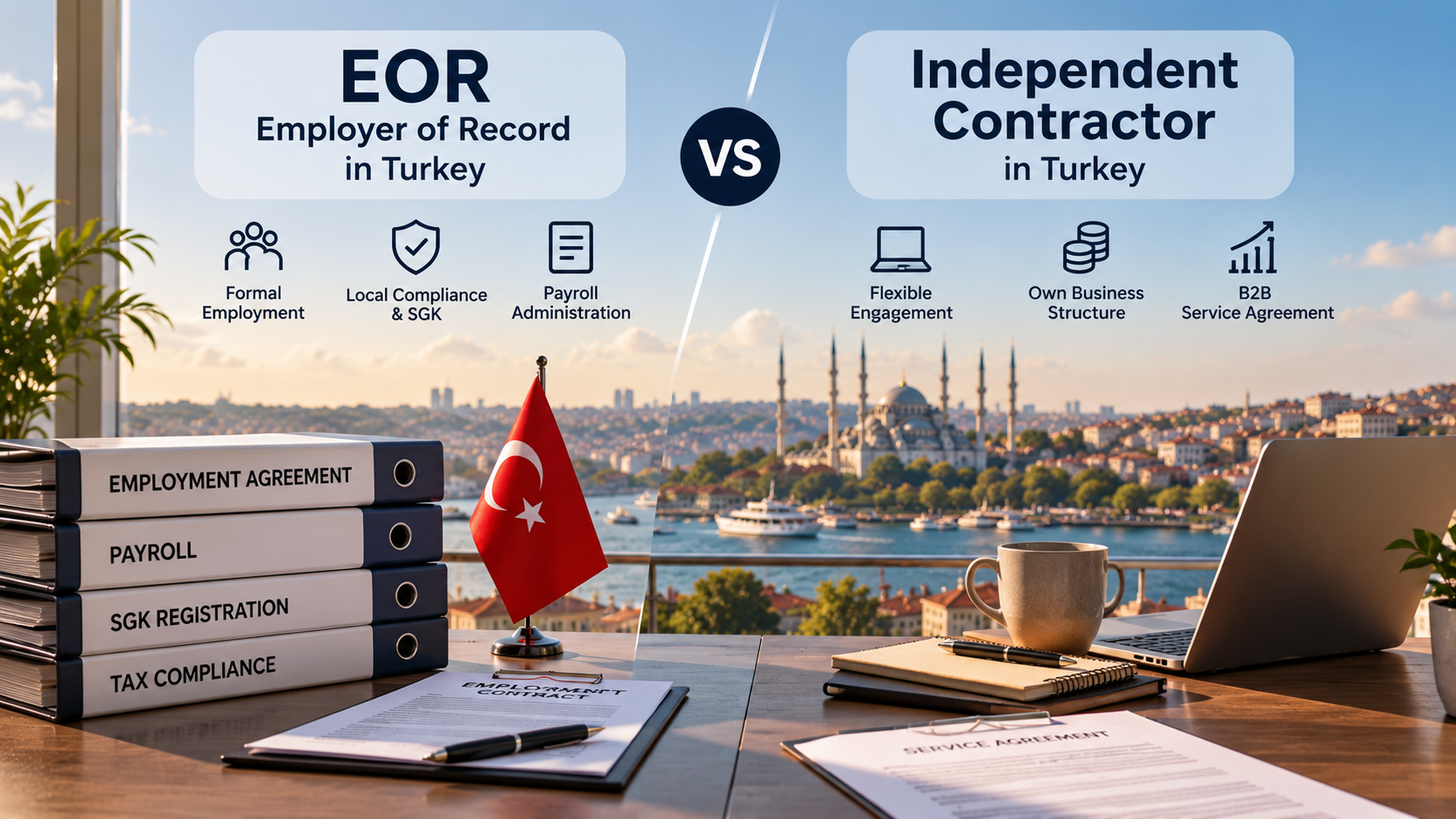
EOR vs. Independent Contractor in Turkey is an important comparison for foreign companies planning to engage professionals in Turkey without establishing their own local entity. While both models can provide a practical way to work with local talent, they create fundamentally different legal, tax, social security and operational relationships.
Under an EOR arrangement, the individual is formally employed in Turkey. Local payroll, social security contributions, employment documentation and other employer obligations are administered through the Turkish EOR company.
An independent contractor, by contrast, provides services on a business-to-business basis, typically invoices the foreign client through their own business structure, and manages their own tax, accounting and applicable social security obligations.
The appropriate model should therefore be based primarily on how the working relationship will operate in practice, rather than simply on which option appears less expensive or easier to administer.
What Is an Employer of Record (EOR) in Turkey?
An Employer of Record allows a foreign company to employ personnel in Turkey without establishing its own Turkish entity solely for that purpose.
Under this structure, the EOR becomes the individual’s legal employer in Turkey. The foreign company continues to manage the employee’s business activities and role, while the EOR manages the local employment relationship and statutory administration.
An EOR arrangement typically includes:
- preparation and administration of the employment agreement;
- employee onboarding;
- Social Security Institution (SGK) registration;
- monthly payroll calculations;
- income tax and social security withholding;
- payroll declarations and statutory filings;
- annual leave and employment records;
- expense and benefit administration where applicable; and
- termination and offboarding procedures.
The individual therefore receives a regular salary through Turkish payroll and remains within the Turkish employment and social security system.
This model is particularly useful for international companies that want to hire one or more employees in Turkey but do not yet have a Turkish subsidiary.
For a more detailed explanation of the structure and local employment process, see our Employer of Record (EOR) Services in Turkey guide.
What Is an Independent Contractor in Turkey?
An independent contractor does not become an employee of the foreign company or an EOR provider.
Instead, the relationship is established on a business-to-business basis.
In practice, an individual professional in Turkey may establish a sole proprietorship (şahıs işletmesi) and provide services through that business. Depending on the circumstances, another corporate structure may also be used.
The contractor generally:
- provides services under a commercial agreement;
- issues invoices for those services;
- maintains their own accounting records;
- manages their own tax obligations;
- handles their applicable social security obligations; and
- operates as an independent business rather than as an employee.
Contractors providing cross-border services may also need to consider the Turkish tax treatment of their income. For further guidance on individual and cross-border taxation, see our tax advisory resources at Metropol Partners.
The contractor model can provide considerable flexibility for both parties, particularly for project-based or genuinely independent professional services.
However, establishing a sole proprietorship and issuing invoices does not, by itself, determine whether a working relationship is genuinely independent.
The actual nature of the relationship also matters.
EOR vs. Independent Contractor in Turkey: Key Differences
When comparing EOR vs. Independent Contractor in Turkey, the most important distinction is the nature of the legal relationship rather than the location of the professional or the way they are paid.
Although both structures can be used by foreign companies working with professionals located in Turkey, the underlying relationships are very different.
| Area | Employer of Record (EOR) | Independent Contractor |
|---|---|---|
| Legal relationship | Employment | B2B service relationship |
| Turkish employer | EOR company | No local employer |
| Main agreement | Employment agreement | Service agreement |
| Payment | Salary | Payment against invoice |
| Turkish payroll | Yes | No employee payroll |
| SGK | Employee registration | Contractor’s applicable social security structure |
| Income tax | Withheld through payroll | Managed through contractor’s own tax structure |
| Paid annual leave | Employment entitlement | Subject to commercial agreement |
| Working time | Employment rules apply | Based on independent service arrangement |
| Termination | Employment law requirements must be considered | Primarily governed by the service agreement and applicable law |
| Business independence | Employee works within employer structure | Contractor should retain genuine independence |
| Typical use | Long-term and integrated team members | Independent or project-based services |
Neither model is automatically preferable.
The central question is whether the company intends to employ an individual as part of its organization or purchase services from an independent business.
When Does an EOR Make More Sense?
An EOR is generally more appropriate when the company actually intends the individual to function as an employee.
This may be the case where the individual:
- works as part of the company’s regular team;
- reports to a company manager;
- performs an ongoing role rather than a specific independent project;
- follows working arrangements determined substantially by the company;
- is subject to regular managerial direction and supervision;
- is integrated into the company’s internal organization; or
- is expected to remain with the company on a long-term basis.
Consider a foreign technology company that wants to hire a software developer in Turkey.
The developer works full-time for the company, reports to its engineering manager, participates in internal meetings, collaborates with other employees and performs an ongoing role within the engineering department.
The fact that the developer works from Turkey rather than from the company’s headquarters does not necessarily make the relationship independent.
In this type of situation, an EOR can provide the Turkish employment infrastructure while allowing the foreign company to integrate the individual into its international team.
When Does an Independent Contractor Model Make More Sense?
A contractor arrangement is more natural where the professional is genuinely providing services as an independent business.
For example, the individual may:
- provide a specific service or deliverable;
- work on a defined project;
- retain meaningful control over how the services are performed;
- organize their own working arrangements;
- operate using their own business infrastructure;
- invoice the client for services; and
- assume responsibility for their own business administration.
Consider a foreign company that hires a Turkey-based software consultant to develop a specific integration.
The consultant determines how the project will be performed, provides the agreed deliverables, invoices the client through their own business and manages their own accounting and tax compliance.
That commercial relationship is substantially different from hiring someone to occupy a permanent position within the company’s internal organization.
This distinction becomes particularly important when considering worker classification.
Independent Contractor Misclassification Risk in Turkey
One of the most important issues when comparing an EOR with an independent contractor arrangement is employee misclassification.
A service agreement can state that the parties have an independent contractor relationship. However, simply calling someone an “independent contractor” does not necessarily determine the legal nature of the relationship.
The practical circumstances under which the services are performed also matter.
For example, a contractor arrangement may become more difficult to distinguish from employment where the individual is heavily integrated into the client’s organization, operates under substantial managerial control and effectively performs the same role as an ordinary employee.
There is no single contractual clause that automatically eliminates this issue.
A properly drafted contractor agreement is nevertheless important and should address matters such as:
- scope of services and deliverables;
- fees and invoicing;
- responsibilities of the parties;
- confidentiality;
- intellectual property rights;
- data protection;
- liability;
- termination; and
- applicable law and dispute resolution.
The distinction between employment and independent services is also relevant when structuring employment contracts in Turkey, particularly because the substance of the relationship matters alongside the wording of the agreement.
For a more detailed analysis of classification factors and practical examples, see our guide to independent contractor misclassification in Turkey.
Does an Independent Contractor Need to Establish a Company in Turkey?
Professionals regularly providing independent services from Turkey generally need an appropriate structure through which their commercial activity can be carried out and invoiced.
For many individual professionals, establishing a sole proprietorship is a practical option.
A sole proprietorship can generally be established more simply than a limited liability company and allows the professional to issue invoices and conduct their activity as an independent business.
Once established, the contractor becomes responsible for the applicable:
- bookkeeping and accounting requirements;
- tax declarations;
- invoicing requirements;
- social security obligations; and
- other compliance requirements associated with the business.
Depending on the nature of the services and how they are supplied to a customer abroad, certain Turkish tax treatments or incentives may also be available.
However, tax incentives for exported services are subject to specific statutory conditions. They should therefore be reviewed based on the contractor’s actual activity rather than assumed to apply to every professional providing services to a foreign client.
Can a Foreign Company Hire in Turkey Without a Local Entity?
Yes.
A foreign company does not necessarily need to establish a Turkish subsidiary simply because it wants to work with an individual located in Turkey.
If the company wants an employee, an EOR can provide the local employment infrastructure.
If the company needs services from a genuinely independent professional, a B2B contractor relationship may instead be appropriate.
There is also a third option: establishing a company in Turkey and employing personnel directly.
Company establishment may become more appropriate when the business plans to build a larger local team, develop permanent operations in Turkey or conduct other activities requiring its own Turkish presence.
The three structures can therefore be viewed as:
EOR → employment without your own Turkish entity
Independent contractor → B2B service relationship
Turkish company → direct local employment through your own entity
The appropriate structure depends on the nature and scale of the company’s activities in Turkey.
EOR vs. Independent Contractor in Turkey: Cost Considerations
Contractor arrangements can appear less expensive than employment because the cost structures are fundamentally different.
EOR Cost Structure
Under an EOR arrangement, the total cost generally consists of:
Gross salary + employer-side statutory costs + applicable employment expenses + EOR service fee
The EOR administers the employee through Turkish payroll and handles the associated employment compliance.
Independent Contractor Cost Structure
Under a contractor arrangement, the foreign company generally pays an agreed service fee against an invoice.
The contractor then manages the tax, accounting and applicable social security obligations arising from their own business.
This can produce a different overall cost structure from employment.
However, the lowest-cost structure is not necessarily the appropriate structure.
If the intended working arrangement has the characteristics of employment, using a contractor structure solely to reduce payroll costs can create unnecessary classification and compliance risks.
The first question should therefore be what type of relationship the parties actually intend to establish. Cost comparison should come after that determination.
EOR vs. Independent Contractor in Turkey: Which Model Fits the Relationship?
A useful way to approach the decision is to describe what the company actually expects from the professional.
If the intention is:
“We want this person to join our team, report to our management and work with us as a regular employee, but we do not have a Turkish entity.”
an EOR structure will generally reflect that intended relationship more naturally.
If the intention is:
“We need an independent professional or business to provide a specific service while maintaining their own business organization.”
a contractor arrangement may be more appropriate.
This is why EOR and independent contractor arrangements should not simply be viewed as two alternative pricing models for the same hire.
They represent different legal and operational relationships.
How Metropol Consulting Supports Companies in Turkey
Metropol Consulting supports foreign companies using both employment and independent contractor structures in Turkey.
Employer of Record Services
For companies that need employees in Turkey without establishing their own local entity, we provide EOR support covering:
- employment documentation;
- employee onboarding;
- SGK registration;
- monthly payroll;
- tax and social security compliance;
- employee administration; and
- termination and offboarding support.
Independent Contractor Support
Where a genuine independent contractor structure is appropriate, we can assist with:
- sole proprietorship establishment;
- tax registration;
- accounting and bookkeeping;
- invoicing;
- ongoing tax compliance; and
- contractor-related administrative support.
Company Formation
For businesses that decide to establish their own operations in Turkey, Metropol Consulting also provides company formation, accounting, payroll, tax and ongoing corporate compliance services.
This allows international companies to choose an appropriate structure for their current needs and adapt that structure as their activities in Turkey develop.
Frequently Asked Questions
What is the difference between an EOR and an independent contractor in Turkey?
An EOR arrangement creates an employment relationship. The worker is employed by a Turkish EOR company and receives their salary through local payroll. An independent contractor instead provides services as a business and invoices the foreign client.
Can a foreign company employ someone in Turkey without opening a company?
Yes. A foreign company can use an Employer of Record to employ personnel locally without establishing its own Turkish company solely for employment purposes.
Can a foreign company work with an independent contractor in Turkey?
Yes. A Turkey-based professional can provide services to a foreign company through an appropriate business structure. The arrangement should reflect a genuine independent commercial relationship.
Can an independent contractor establish a sole proprietorship in Turkey?
Yes. A sole proprietorship is commonly used by individual professionals carrying out independent commercial or professional activities in Turkey. The appropriate structure should nevertheless be determined according to the individual’s activities and circumstances.
Is an independent contractor cheaper than an EOR in Turkey?
The cost structures are different. EOR employment includes payroll and employer-side statutory costs, while contractors manage their own business taxes, accounting and applicable social security obligations. Cost should not be the sole factor used to determine the appropriate classification.
Is signing an independent contractor agreement enough?
No. A written service agreement is important, but the practical nature of the relationship also matters. The agreement should accurately reflect how the parties actually intend to work together.
Can an independent contractor work for only one foreign company?
Working with a single client does not by itself provide a complete answer as to whether a relationship is employment or independent contracting. The overall relationship and the way the services are actually performed should be considered.
What are the risks of contractor misclassification?
Where a relationship documented as B2B operates in practice like employment, employment, social security and tax-related issues may arise. Companies should therefore determine the appropriate structure before onboarding rather than relying solely on the title of the agreement.
Should we use an EOR or establish a company in Turkey?
An EOR can be practical when a foreign company needs a limited number of employees without establishing its own entity. Establishing a Turkish company may become more appropriate where the business plans a larger team, permanent local operations or other commercial activities in Turkey.
Choosing the Right Structure
Choosing between EOR vs. Independent Contractor in Turkey requires looking at the actual working relationship, the level of independence and integration, and the company’s longer-term plans in Turkey.
An EOR is an employment solution. An independent contractor arrangement is a B2B service relationship.
The appropriate choice depends on the actual working relationship, the level of integration and independence, the company’s plans in Turkey and the responsibilities the parties intend to assume.
Metropol Consulting supports foreign companies with EOR, payroll, independent contractor compliance and company establishment in Turkey.
If you are planning to engage a professional or build a team in Turkey, contact us to discuss the appropriate structure for your requirements.